

I first published this story in April 2024.
My writing has changed since then. This version is closer to the voice I was looking for.
I have been in Mozambique for a month and so far nothing is according to plan.
I can still close my eyes and remember driving through the empty streets of Maputo a month earlier. The eery feeling, the slow pace of the vehicle in a city under 24h curfew. A rain of purple flowers from the tall jacarandas bordering the boulevard. I slid a tape in my walkman. “Purple Rain” played while the petals fell.
I thought of Enid that I left in New York. We did not say goodbye but we both knew it was the end.
I came here to review the security and communication protocols for the mission. The cholera epidemic had put a real strain on the team.
A 2h flight to Quelimane. A long and bumpy drive to Mocuba.
Heat, exhaustion, dehydration. Kidney stones. Hospital. Back to work.
Barely recovered, the rebels lead an offensive. Night evacuation to Zimbabwe. Hospital again.
Back to Mozambique. Driving over a land mine on the way to a camp.
A very intense month. I have been living in Africa for over four years by then. I am used to this, but I am exhausted.
Quelimane. This is my last domestic flight. I am ready to go home.
The plane is full except for the seat beside me. Delays are normal for LAM (Linhas Aereas de Mocambique), but we are waiting for a last passenger.
Hot, humid, stuffy. We all sit and sweat patiently. Even the chickens.
The less I move, the more acceptable it is.
Two large United Nation officers in blue uniform enter the plane in company of a tiny old man. Abducted by the rebels and later released, he is being sent back to his village. He is my seatmate for this flight.
The rebels punished him for trying to escape.
They cut off his eyelids. His ears. His nose. His lips.
Everything that makes a human face.
He can’t blink. His eyes bulge, raw and wet, always crying.
His mouth never closes, saliva pooling and dripping.
His gums have peeled back, teeth exposed and decayed.
Where his nose had been, a dark void.
The smell is of decay, something I learned to recognize and never got used to.
It is nearly impossible to witness.
But looking away feels like betrayal.
So I do what I can. I speak, my voice cracked, in broken Portuguese.
Words don’t matter. Not looking away is the only decent option.
The food finally comes in the cheapest plastic tray imaginable, thin, flimsy, barely holding. No one expect better. We are more cargo than passengers.
I am not hungry. I eat what I am given.
I can hear him struggling. His lips can’t close around the fork. He fights to keep every bite in with his hands, trembling, piece by piece.
Then I watch him clean his tray. Reverently.
He wipes the plastic spoon, the fork, the tray itself with deliberate care.
He folds the limp paper napkin as one would fold fine silk.
Each movement slow, precise.
Then he tucks the bundle into a small cloth bag at his side.
As if he has just been handed a gift beyond measure.
I break.
I have seen the most excruciating moments, but nothing tears me open like the way this man handles a disposable spoon.
I mimic his movements, wiping my own tray, my own spoon. Then I turn to him and offer them.
Instead of reaching for the utensils, he reaches for my hands.
I feel the callous skin of his palms, the bony fingers with barely any flesh left. Skin to skin. A shiver. Something moves through me.
Then he leans forward and presses his forehead to my hands.
“Obrigado, obrigado,” he whispers, again and again.
More than thirty years later, I still cannot recount this without crying.
To this day, I cannot pass a trash bin filled with discarded plastic cutlery without thinking of him. Every time.
What kind of world are we living in, where a plastic spoon is a sacred object to one man, and landfill to another?
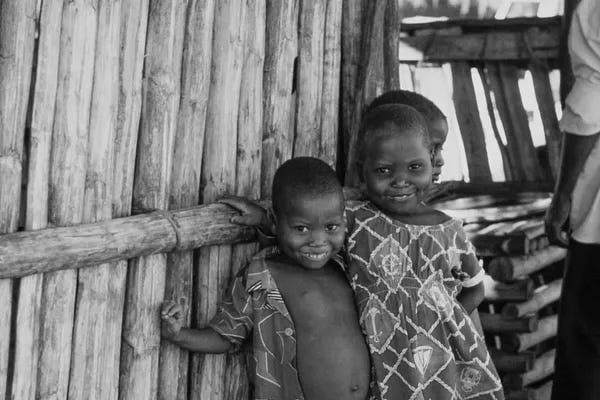
Post Scriptum
At the time of this story, President Joaquim Chissano was slowly guiding Mozambique out of civil war, attempting to build a republic from devastation. His reformist approach got his government flagged as Marxist, placing it in the crosshairs of Cold War logic.
The rebel group RENAMO was known for its brutality. Covertly funded by Western interests under the pretext of ideological balance, they abducted entire villages. Men were forced into agricultural servitude. Women were used as sexual slaves.
Punishment for attempted escape was unspeakable. Torture was not just control. It was a message. A public ritual of fear designed to keep others in line.
Coming from the West, I still freeze at the thought that even a fraction of the taxes I paid may have helped fund this barbarity. Unknowingly, I was an accomplice. I cannot say “I did not know.”
And I wonder: what about today’s taxes? What barbarity do they serve?
Subscribe — or even better, become a paid subscriber. Once I reach 100 paid subscribers (I’m already halfway there!), Substack will add a tag that could help me gain more visibility.

Engage (free and powerful!) — Visit the website, find the post you enjoyed most, and leave a comment at the end. Extra karma point if your comment is impertinent, sassy or even contains a question!
PS: “Change Your Story, Change The World” is a storytelling endeavor that looks deeply into the psyche that creates the stories we live by—with the intention to help us shape better stories, both personally and collectively.
Because the stories we tell are not just stories—they are the reality we live.
What an absolute gut punch to read - that human beings can be so limitlessly vicious and at the same time others can see something limitlessly holy in each other. This needs to be read widely.
Oh, Gabriel, this is so deeply human and heartbreaking. What gratitude he showed, despite his horrific wounds. And now, thanks to your beautifully honest way of describing your experience, I too will never think of a plastic spoon the same way. ❤️