

Between 2010 and 2024, dystopian film production grew by 100%, outpacing total film production which grew by 82% in the same period. The genre is expanding faster than cinema itself.
This is not a trend. It is an acceleration.
And the question I want to raise is not why we are watching more dark futures. It is what happens to a civilization that spends an increasing share of its creative energy rehearsing its own collapse.
There was a time when dystopian movies were warnings.
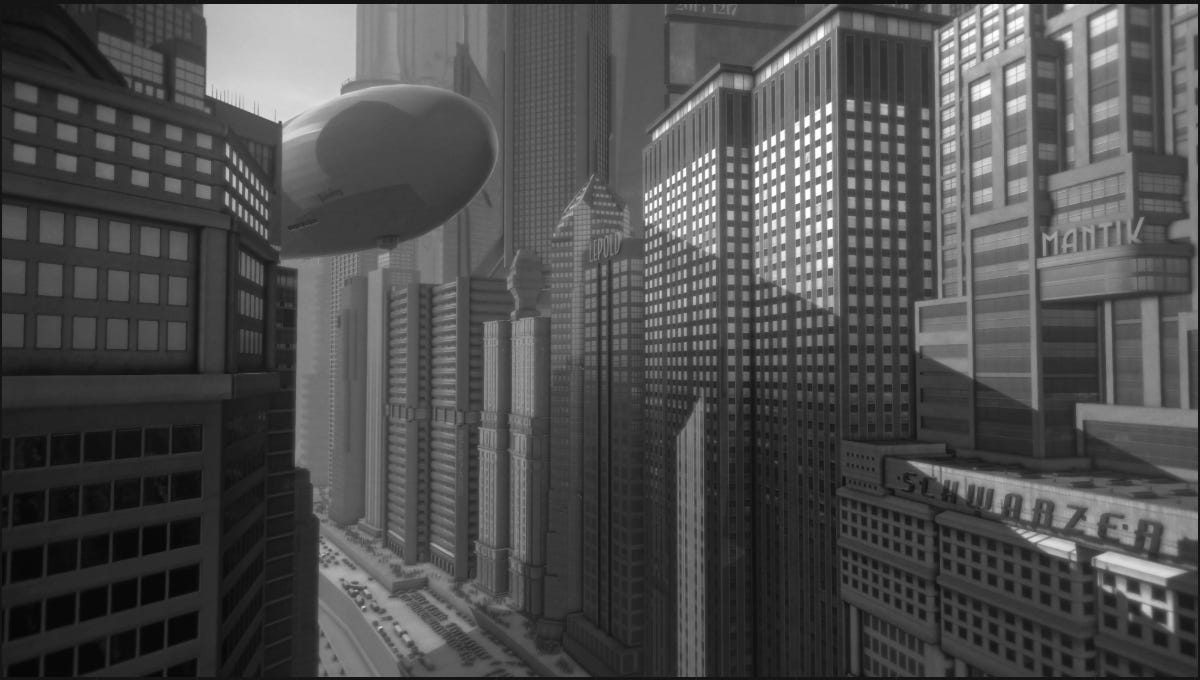
Metropolis, 1927. Fritz Lang built a vertical city out of miniatures and painted backdrops to tell us about the separation between rich and poor. You could see the craft. You could see the sets. The distance between you and the image was the space where the message lived: pay attention, this is where we could go.
Soylent Green, 1973. A world of overpopulation and ecological collapse set in 2022 (!), where the poor survive on processed wafers that turn out to be made from human corpses. The sets looked like dressed-up soundstages because they were dressed-up soundstages. But the idea landed like a punch. You didn’t need photorealism. The metaphor did the work.
Tarkovsky’s Stalker, 1979. Three men walking through an industrial wasteland toward a room that grants your deepest desires. No explosions, no battles. Just decaying concrete and long silences and a camera that refuses to look away. A Russian philosophical poem disguised as science fiction, shot on film stock that had to be thrown out and reshot because the Soviet processing lab ruined it. The limitations were part of the language.
These films were cautionary tales.
They functioned as cautionary tales precisely because they looked like cautionary tales. The gap between the image and reality was where the warning could be heard. You watched 1984 or A Clockwork Orange or Logan’s Run knowing you were watching a construction. And that knowledge is what allowed you to step back and think.
Then something changed.
Compare David Lynch’s Dune, 1984, with Denis Villeneuve’s Dune, 2021. Same source material. Forty years apart. Lynch was working with physical sets, practical effects, and limited compositing. Whatever you thought of his film, you knew you were watching a fabricated thing. The seams were showing. Villeneuve’s Dune drops you into the desert of Arrakis and you cannot tell where the real sand ends and the digital sand begins. The craft has become invisible. The construction has disappeared.
Or take the film that started this reflection for me. I saw the original Blade Runner when it came out. 1982, I was 21. I loved science fiction. It was fun. The rain-soaked streets, the neon, the flying cars. It was clearly a movie. A beautiful one, but a movie.
Then I watched Blade Runner 2049. And I had chills down my spine.
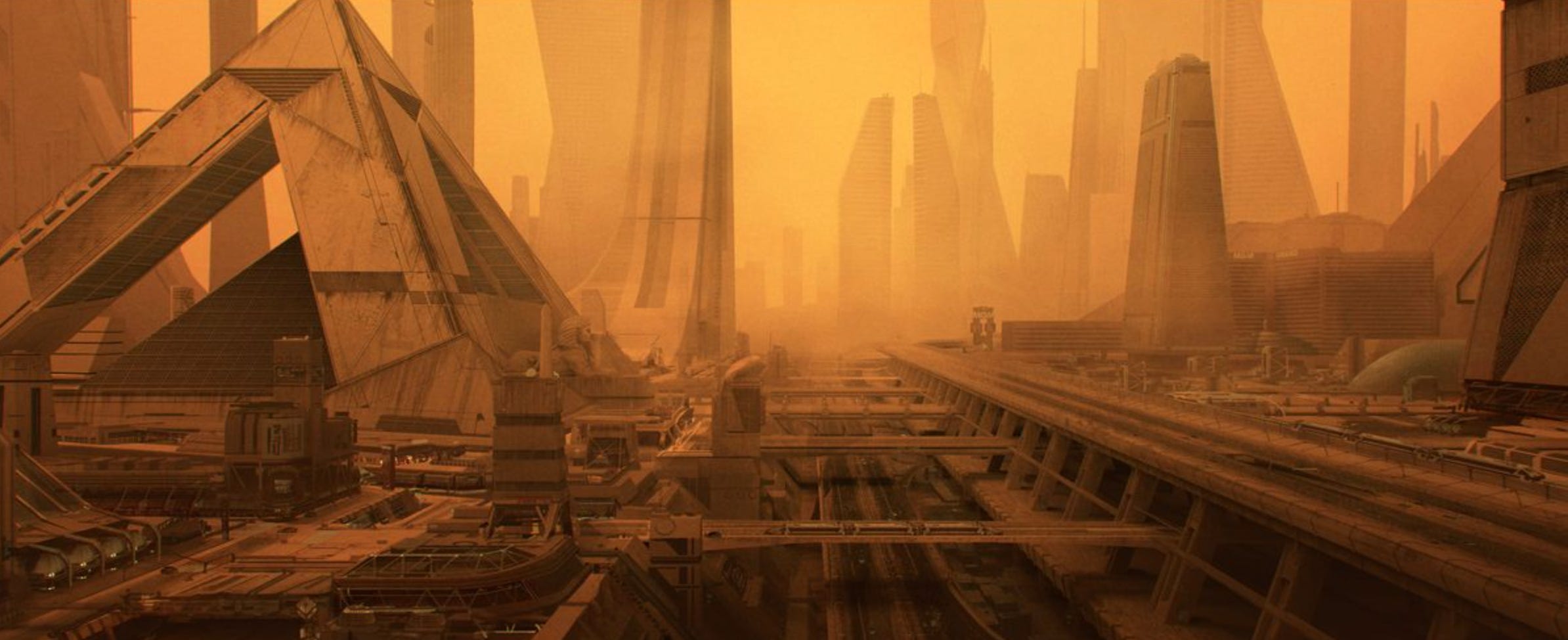
Not only because the story was darker. Because the image was real. The vast, empty landscapes. The managed desolation. The human beings who aren’t fighting the system but metabolized by it. The original had noir romance to it. The sequel is just bleak infrastructure. And it doesn’t feel like cinema.
It feels like you’re looking through a window at something just about to happen.
Here is the pivot.
When visual technology crosses the threshold of photorealism, the cautionary tale becomes a preview.
In the 1970s, Soylent Green felt like a parable. In 2017, Blade Runner 2049 felt like a premonition. The image had become indistinguishable from footage. The viewer’s nervous system does not differentiate between a real wasteland and a perfectly rendered one. The brain rehearses what it sees.
We know this at the individual level.
Sports visualization works.
Therapeutic imagery works.
Guided meditation works.
The mind does not fully distinguish between a vividly imagined experience and a lived one. This is the basis of every practice from cognitive behavioral therapy to shamanic journeying.
Now scale it to billions of viewers, all immersed in the same photorealistic collapse, the same surveillance states, the same empty cities, the same managed despair.
What you get is collective visualization operating at industrial scale. We are not being warned about a future. We are being trained to expect it.
The story we tell is the story we live.
And we are telling the same story, louder and more convincingly, every year.
Imagination itself is captured, look at Avatar.
James Cameron had a premise that could have broken the pattern: first contact with an alien civilization, a chance to imagine what it looks like when two radically different species meet and find a way to coexist. The technology to render anything he could dream of. A global audience ready to follow him wherever he went.
And where does he take it? Straight to the military battle. The indigenous people fight the colonizers with bows and arrows and flying creatures, and somehow they win, and the humans are sent packing. It’s the same story humanity has been telling since the Iliad. Three films deep, it just keeps doubling down on the battle. Each sequel more militarized than the last.
This is not a failure of resources. It is a failure of imagination.
And I’d argue the resources are part of the problem. When you can render anything, when every technological constraint has been removed, you lose the friction that forces artists to be inventive. Real talent is the ability to spin art despite constraints, to find something new precisely because the obvious path is blocked. Cameron’s situation was the opposite.
Every path was open, and he walked the oldest one.
But there is something deeper going on here. Cameron isn’t just failing to imagine a different ending. He’s writing for the audience he has. And the audience wants what it knows: the enemy defeated, order restored through force. Violence as resolution.
Control as the answer to chaos.
We try to resolve problems using the same level of consciousness that created them, and cinema reflects that loop with total fidelity. The mess was made by force. The resolution is more force. The story never actually moves.
The real artist writes from a place the audience hasn’t reached yet, and pulls them there through the work. That requires a willingness to risk the audience not following. Cameron can’t afford that risk. The investment won’t allow it. And so the most technologically advanced films ever made deliver the oldest, most primitive resolution available: we win, they lose, roll credits.
The structural dimension that goes beyond any filmmaker.
Drama needs conflict. Narrative runs on tension. A story about a couple at the brink of divorce has something. A story about a couple living harmoniously has nothing. No one makes a movie about a cop who has no problems and lives beautifully. It would be unwatchable. This has been true since Homer. The engine of narrative is trouble.
But a conflict in a story does not mean the story must end in destruction.
Joseph Campbell mapped this a long time ago. The hero’s journey descends into the underworld. It passes through crisis, loss, confrontation with death. The tension is real. But the arc completes. The hero returns, transformed, carrying something back for the community. The descent is not the destination. It is the passage.
What we see in contemporary dystopian cinema is something different. The stories descend and stay down. Or they resolve through violence and rebuild from ashes, which is just another way of staying down. The arc collapses into the abyss instead of passing through it. The consciousness that created the problem is the same consciousness that attempts the resolution, and so nothing actually shifts.
The world burns, is rebuilt with the same blueprints, and we call it a story.
I explore this pattern in depth in my upcoming book Locked In (lockedinthebook.com, March 2026).
But the short version is this: a civilization that cannot imagine resolution beyond control will keep producing stories that end in control.
The cinema is not the cause.
It is the mirror. And right now, the mirror is showing us exactly where we are.
You can make a gripping film that takes us through the full catastrophe and arrives somewhere we haven’t been before. That is what a real story arc does. The fact that almost nobody in cinema is even attempting that landing is the actual problem. Not that conflict exists in the story, but that the story never completes its own journey.
We have become very good at the descent. We have forgotten how to come back with the elixir.
Question of scale.
The experiences that actually shift consciousness, ceremony, embodied practice, direct encounter between humans in a room, these do not need narrative tension to be profound. But they don’t scale. They don’t film. A ceremony reaches twelve people. A movie reaches twelve million. And if you try to scale the ceremony to a stadium, it stops being a ceremony.
So we have built an enormous beast of communication that feeds on drama and dark futures, that has been growing for a century, and that now reaches billions. And on the other side, we have small, local, embodied practices that actually work on consciousness but cannot compete. Not even close. It is not David and Goliath. The asymmetry is much bigger than that.
One more layer.
The same technology that makes dystopian cinema indistinguishable from reality is the same technology now producing deepfakes, AI-generated media, and synthetic news.
The visualization machine and the disinformation machine are the same machine.
The tools that allow Villeneuve to make Arrakis look real are the tools that allow anyone to make anything look real.
We can no longer reliably tell whether we are watching the news or watching a movie. And this is not a glitch. This is the environment we now live in. Fiction and reality have merged at the level of the image, and once the image becomes indistinguishable, the distinction between warning and blueprint collapses too.
We are not making movies that pretend to be separate from reality. We are making movies that look like reality. And reality is starting to look like the movies.
I won’t offer a resolution for this.
I know people want the last paragraph. The one that says, here’s what we can do, here are three steps, here’s the hopeful turn. I’m not going to write it. Not because I’m a pessimist. Because I think the honesty of the observation matters more than the comfort of a premature answer.
We have spent the last hundred years building the most powerful storytelling infrastructure in human history. We have refined it, funded it, globalized it, and now supercharged it with technology that erases the line between fiction and reality. And what does this machine produce? Dark futures. Surveillance states. Ecological collapse. Military resolution to every conflict. Over and over and over, with increasing realism and accelerating frequency.
The story we tell is the story we live.
We’ve been telling the same one for a while now.
And the tools we’re using to tell it have never been more convincing.So I wonder: What future are we designing?
Engage (free and powerful!) — Visit the website, find the post you enjoyed most, and leave a comment at the end. Extra karma point if your comment is impertinent, sassy or even contains a question!
PS: “Change Your Story, Change The World” is a storytelling endeavor that looks deeply into the psyche that creates the stories we live by—with the intention to help us shape better stories, both personally and collectively.
Because the stories we tell are the reality we live.
This hits on a crucial cultural storytelling problem that has caused me to build a network of storytellers for co-dreaming evolutionary myths with.... we are starting with this: https://www.stinerbros.com/blades-of-grass
I so appreciate this post. It makes me feel very optimistic, because it reminds us that we have all the tools we need to build the future we want for ourselves and each other. All we need is the will, and there are more people every day rising to that challenge. Thanks for sharing this.