

I- The Culprits
In August 1971, a corporate lawyer named Lewis Powell wrote a memo, a confidential strategy document addressed to the US Chamber of Commerce.
The memo was a battle plan. Powell had looked at American society and concluded that business was under existential threat, from environmentalists, consumer advocates, academics, the press.
His prescription was total: capture the institutions. Fund think tanks. Infiltrate university boards. Build a legal pipeline. Own the referees so you never have to worry about losing the game.
Within a decade the Architecture was built: the Heritage Foundation, Cato Institute, the American Enterprise Institute, the Business Roundtable. None of these are secret organizations, none of this is hidden. They published their goals, held conferences, trained generations of judges, economists and politicians in a coherent ideological framework. The Federalist Society alone has placed six of the current nine Supreme Court justices.
This is not conspiracy theory. It’s public record. The documents exist. The money trails are documented. The results are visible in every major institutional decision of the last 50 years.
Then the project found its political vehicles.
One by one, across party lines, each administration added its layer.
Reagan, 1981, fired 11.000 air traffic controllers, broke the unions and cut the top tax rate from 70% to 28%. People who made money from work paid taxes. People who made money from money, much less so.
Bush Senior went to war in 1991. $61 billion, almost nothing compared to what his son will do 10 years later.
Clinton passed NAFTA in 1994. Then in 1999 he unlocked the casino and let the banks play with your savings. Nine years later the house lost. You paid.
Bush Junior, 2001 cut taxes on capital — if your income came from investments you now paid roughly half what wage earners paid. Then fought two wars on borrowed money: the bill — over three trillion dollars.
Obama, the banks crashed the system in 2008. Obama saved the banks. Eight million families lost their homes. Nobody went to prison.
Trump cut corporate taxes to 21% permanently in 2017. Corporations used the savings to buy back their own stock. Executive bonuses followed. Wages didn't.
Biden printed money, gave it to the financial system, watched asset prices inflate. If you owned stocks you got richer. If you didn't, your rent went up.
The through-line is uninterrupted.
Republican and Democrat, it makes no difference.
Every administration inherited the logic and extended it. Some with conviction, some with pragmatism, some saying it was damage control. The result was the same: each decade the wealth moved further up, the institutions weakened further, the middle class thinned further, and the language of freedom was used to describe each step of the process.
If you are still waiting for the right election to reverse this, you are misreading the nature of what was built. This was not a series of policy mistakes. It was a system performing exactly as designed — across administrations, across parties, across decades.
The plan worked perfectly.
Which is exactly when it stopped being their plan.
II- The Serpent Takes Over
The discreet old-money establishment that drew up the blueprints understood one thing above all: the legitimacy of the system was an asset. You don’t want to kill the host, you want to extract from it indefinitely, quietly, across generations. The game required patience and the appearance of normalcy.
What their system generated instead, once the guardrails were gone and capital had nowhere left to flow but upward, were people for whom patience is weakness and appearances are for losers.
The tech oligarchs didn’t build the road. They arrived after the architecture was complete and the safety turned off. No gentlemen’s agreement. No strategic patience. No interest in maintaining the host. They had grown up inside a different logic entirely — Silicon Valley’s winner-take-all, move-fast-and-break-things ethos that had no institutional memory of why the guardrails existed in the first place. To them the remaining constraints weren’t a necessary cover story. They were just friction.
The old establishment — the think tank world, the traditional donor class, the discreet men in good suits who funded the fifty-year project — did not plan for someone who would dismantle federal agencies on a live stream while his followers cheered. They wanted a stable system they could reliably extract from. What they got was someone who finds the extraction insufficient — who wants the architecture itself, the state machinery, the direct operational control that their gentlemen’s agreement had always kept at arm’s length.
The latest President is the political expression of the same logic. Not its cause. Its symptom and its accelerant simultaneously — the figure the system produced when it had sufficiently hollowed out the institutions that would previously have made him impossible.
The architects didn’t plan for that part. Remove enough structural constraints and eventually someone arrives who doesn’t share your assumptions about what the constraints were for — or your agreement about how far you were willing to go.
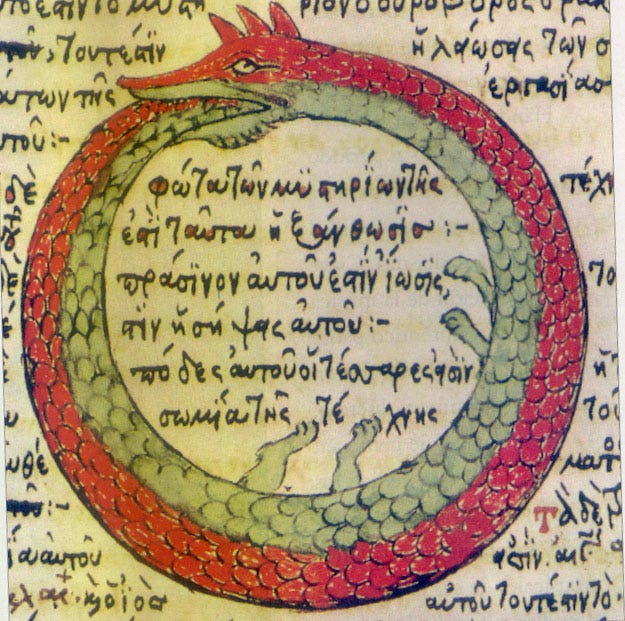
The original architects built the mouth of the snake.
They just didn’t expect it to bite the tail.
III- A Crime with no Name
This is where the story stops being a political story.
Everything above — the wealth concentration, the institutional capture, the democratic erosion — is in principle recoverable. You can reverse Citizens United with a constitutional amendment. You can rebuild unions. You can restructure the tax code. Damaged institutions can be repaired given enough time and political will.
You cannot un-release the carbon.
The specific cruelty of the timing is almost too precise to look at directly. The fifty-year window of the neoliberal project — 1971 to now — is almost exactly the fifty-year window during which decisive action on climate was both scientifically understood and physically possible. Those are not unrelated facts.
Exxon’s own scientists knew in 1977. They ran the models. They understood the trajectory with an accuracy that would later surpass NASA's own public projections.
The company’s response was to bury the findings and spend the next four decades funding doubt — financing a $30 million systematic campaign to make the public uncertain about what their own scientists had already confirmed internally.
This was the intended consequence of pursuing profit. It was a knowing choice to load an existential cost onto everyone else — every living thing, every future generation — and call it business.
There are legal frameworks for “Crime Against Humanity”. There are other legal definitions in the making for long term damage to the environment.
But nothing to define crime against life itself. No legal or philosophical tradition has named that yet, because the crime of that magnitude has not been possible before. It is even hard to conceive that someone would commit such a crime.
The same institutional capture that defunded environmental regulation, installed fossil fuel executives in regulatory agencies, and withdrew the US from every meaningful international climate agreement also happened to occupy the precise historical window when the physics of the situation required the opposite.
The system that was built to concentrate wealth was the same system that made collective response to climate impossible. Not coincidentally. Structurally.
The middle class lost its economic footing.
Democracy lost its functional integrity.
The planet lost the window of opportunity.
These are not three separate crises. They are one crisis at three different scales.
And at the largest scale, the question is no longer about recovery. It is about the framework itself. We keep asking how do we survive this. It may not even be the right question.
What kind of transformation are we actually entering. Every framework we have is built around human survival as the central value. That assumption may simply be the last bastion of denial.
IV- The Return of Dharma
The Mahabharata is not a morality tale. It is not a story about good defeating evil. Almost everyone in it is compromised. The violations of dharma that make the war inevitable are accumulated over decades, by nearly everyone, through small corruptions and large ones, through cowardice and calculation and genuine tragedy. By the time the armies face each other on the field of Kurukshetra, there is no surgical option. No negotiation that hasn’t already failed. No reform that can reach the scale of what has been broken.
The field has to be emptied.
Notice when Krishna appears. Not before to offer alternative. Not after to offer solace. He appears on the battlefield, between the two armies, in the moment of Arjuna’s paralysis, when the man most troubled by the consequences of what is about to happen, the one most qualified precisely because of his reluctance, cannot lift his bow.
The Gita is not a text about avoiding destruction. It is instruction on how to navigate it, without the ownership of outcome that turns action into grasping, without the paralysis that mistakes attachment for conscience.
What we are watching in the world today has the structure and flavor of Kurukshetra. This is not a metaphor any longer. It is a description.
Dharma, the principle of right order, the intelligence that guides each thing to function according to its nature, has been violated so comprehensively, at so many levels simultaneously, that no partial repair is adequate.
The financial system extracts rather than circulates. The political system represents capital rather than citizens. The media system manufactures confusion rather than clarity. The ecological system is being consumed by the economic system that depends on it for survival.
These are not policy failures. They are structural violations that have compounded across decades until the field itself demands clearing.
The destruction is not here to punish. It is consequence. It is karma.
There is a difference, though it offers only cold comfort.
V- The Last Illusion
There is a blind spot beyond all blind spots.
Every analysis of civilizational collapse, including this one up to this point, is still conducted from inside a human-centric frame. The implicit assumption is that this is a human crisis requiring a human solution, the measure of catastrophe is human suffering and the measure of recovery is human flourishing.
That assumption is the same ownership logic that produced the crisis.
We did not create consciousness. We are a temporary experiment inside it, one that developed remarkable facility with manipulating matter and almost total blindness in understanding what it actually is. The belief that our disappearance, partial or total, would constitute a cosmic tragedy is itself the problem restated at the deepest level.
We couldn’t stop owning even the ground of our own awareness.
Kashmir Shaivism is not a human-centric system. Consciousness, Shiva/Shakti, is the ground, not the product. Humans are one of its temporary expressions. The Vijnanabhairava Tantra is not a manual for human flourishing. It is an invitation to recognize what was already present before the human form arose and will remain after it dissolves.
The Tao that can be named is not the eternal Tao. The ten thousand things arise from it and return to it. The arising and the returning are equally Tao. There is no preference in the system for the continuation of any particular form, including the one currently reading this sentence.
This is not nihilism. The grief is real. The beauty of what is being lost is real. Grief and beauty don’t require permanence to be true.
What they require is presence, which is exactly what the ownership illusion prevents.
The men dismantling the guardrails believe they are building something. The men who built the guardrails believed they were protecting something. Both were operating inside the same illusion: that the game belongs to whoever is currently playing it.
It doesn’t. It never did.
VI- What the Old Ones Knew
The wisdom traditions that have lasted long enough to be worth consulting were not offering comfort. They were making an observation about the nature of reality that the modern world, in both its progressive and conservative forms, has systematically refused.
Shiva dances. The dance is creation and destruction simultaneously, not sequentially. The universe is not built and then torn down. It is continuously both. The Nataraja image that has sat in temples for a thousand years is not a metaphor for impermanence. It is a description of the actual structure of existence.
Form arises. Form dissolves. The dancing continues.
The Tao Te Ching opens with the observation that whatever can be fully grasped and named has already lost the thing it was pointing at. The sage leads by not leading, acts by not forcing, and when the work is done the people say: we did this ourselves.
Power that announces itself has already begun its dissolution.
The Gita’s central instruction, act without attachment to the fruits of action, is not spiritual bypassing. It is the most precise description available of what it looks like to operate inside a collapsing system without being destroyed by it or contributing to the collapse through desperate grasping. You do what the moment requires. You release the outcome. Not because outcomes don’t matter but because the attachment to them is what distorts the action.
Plato saw it in the fourth century BC: the people most fit to govern, are precisely those who would prefer not to. The hunger for power is the disqualifying diagnostic.
Twenty-five centuries later we handed the world to the hungriest people we could find.
None of these traditions predicted our specific moment. All of them described its structure.
The cycle is not a failure of the cycle. The mouth of the serpent finding the tail is not a malfunction. It is the form the pattern takes when a particular configuration has exhausted its possibilities.
Something ends. The ground it arose from does not.
VII- The Ground of Being
For 3 decades I have watched systems collapse. Not from a distance, not through screens, up close, in places where the distance between order and chaos turns out to be a single afternoon.
What I know from that proximity is this: the people who navigate collapse most cleanly are not the ones with the best escape plan. They are the ones who stopped pretending the collapse wasn’t happening while everyone else was still maintaining appearances. The clarity itself becomes a kind of ground.
We are in the maintenance-of-appearances phase. It will not last.
The Ouroboros doesn’t need our permission to complete the circle. The mouth is already biting. The men who think they are driving this, the demolition agents who call it construction, the extractors who call it growth, the mouth that doesn’t know it’s the serpent’s own tail, they are not in control of what they’ve set in motion. Nobody is.
That is not despair. Despair is still a form of ownership, the insistence that it should have gone differently, that the right intervention at the right moment could have saved it, that someone is to blame in a way that makes the tragedy avoidable in retrospect.
It wasn’t avoidable. The death was foretold. Not because humans are irredeemably corrupt but because the configuration had run its course and the systems built to correct it had been methodically dismantled by the people who found correction inconvenient.
The planet is not dying. It is changing into something that will not require us in the same way. Consciousness is not threatened by the end of this particular experiment. It was here before the experiment began.
What remains, when the ownership illusion dissolves completely, is not nothing.
It is the ground that was always there.
The serpent will finish its meal.
Something will come that we don’t have a name for yet.
We were never the owners of what that will be.
PS: “Change Your Story, Change The World” is a storytelling endeavor that looks deeply into the psyche that creates the stories we live by.
Because the stories we tell are the reality we live.
This is extraordinary work. I love taking it in from this perspective.
The Ouroboros image carries the entire architecture. That framing is devastating because it’s accurate.
From my background in behavioral economics: I’ve been documenting this for decades. Did my thesis on disparity over 15 years ago…the U.S. was already the most disparate developed country in the world on par with Nigeria. It’s only worse now. That didn’t happen by accident. It happened because the system was designed for extraction. The U.S. was built to be the most capitalist large country in the world, which is why social mobility here is horrific compared to Northern Europe or even Canada.
But here’s the deeper cut you’re making, it all goes back to the founding error. Slavery. The original writing of the Constitution didn’t see slavery as bad, it saw it as perfectly fine. After the Civil War we never learned the lesson. Reconstruction ended, then Jim Crow, then finally the Civil Rights era when Black people and women got full voting rights. International institutions don’t classify the U.S. as a full democracy until the 1960s. Then we start losing that status again in the 1980s.
The U.S. has been a full-fledged democracy for maybe 10-15 years of its entire lifespan. The main goal has always been extraction. Your Ouroboros framework shows what happens when extraction becomes the organizing principle across centuries—-eventually the system eats itself.
The section on climate timing, that’s the cruelty laid bare. Exxon knew in 1977. Buried it. Funded doubt for forty years. “Crime against life itself” with no legal framework because the magnitude was previously impossible. You named something that needed naming.
The old-money establishment understood legitimacy as an asset…you don’t kill the host, you extract indefinitely. The new oligarchs didn’t get that memo. They want operational control, not sustainable extraction. The system produced its own termination logic.
The Mahabharata frame in section IV reorients everything. This isn’t about good defeating evil. It’s structural violations compounding until the field demands clearing. Dharma violated so comprehensively that no partial repair reaches the scale of what’s broken. That’s where we are.
And the final movement (Kashmir Shaivism, the Tao, the Gita) dissolving the human-centric frame entirely. We’re not the ground, we’re a temporary expression. The ownership illusion extends even to consciousness itself.
The people who navigate collapse cleanly are the ones who stopped pretending it wasn’t happening. Clarity as ground. That’s the teaching.
Acceptance is always the first step. I see everything as a Buddhist mandala…absolutely beautiful, everything flows, comes and goes. Non-attachment.
Thank you for this. It’s rare to see someone work at this scale without flinching.
—Johan
This has to be the wisest and most heart-breaking assessment of the present moment I've seen so far. It rings true in a deep and difficult way.