

Zest of life
Monday morning 11 am, Zest is a classy vegan restaurant in Ubud. A far cry from a suburban commute experience for a Monday morning if you ask me.
Zest’s motto is “We hope this is a place where you feel safe to belong.”
Near the tea room a small group has started to gather around a long coffee table. The group is eclectic, a common experience in the hub that Bali has become. People come from all around the world, they seek a new narrative away from mainstream gloom and how easy it is to understand that. Bali has become an international tourist attraction and Ubud has grown into a gravity center of spiritual tourism.
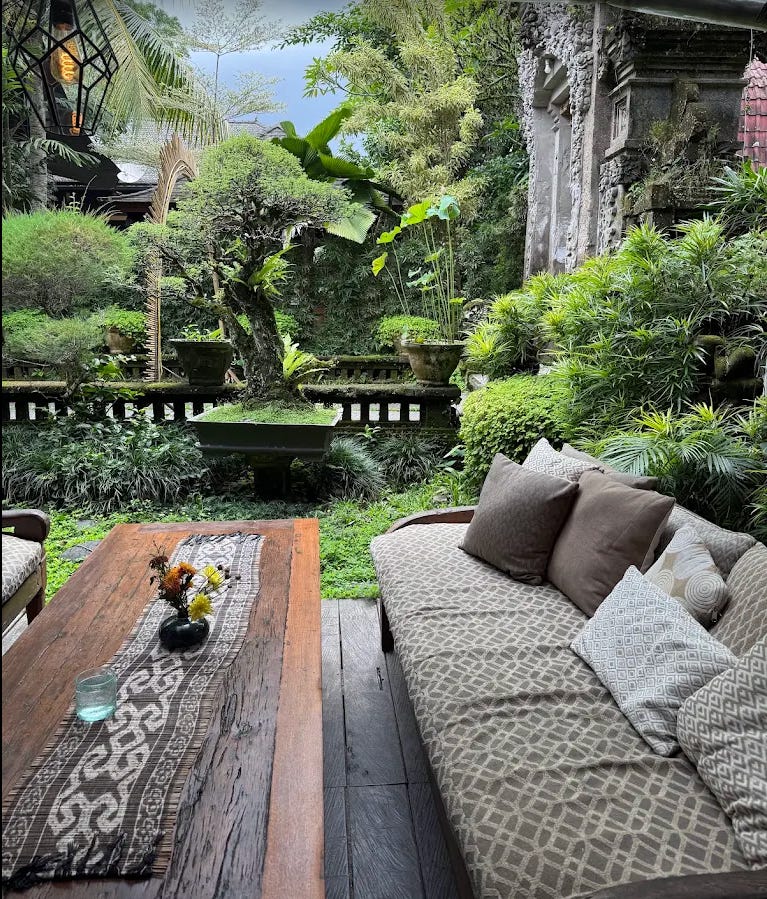
The room is open on one side to a garden that never ends. A tree comes up through the floor and out past the roofline with ferns lodged in its branches. The roof is high and dark, the beams exposed, a line of Balinese script running along one of them. On the long table, a woven runner and a small black vase holding yellow flowers.
There is a sense the usual limitations do not apply here.
It is a beautiful place in which to say something you have never said out loud.
What we came for
I take a look around the table and notice something about who is here.
Almost everyone is from somewhere else. Almost everyone arrived on this island looking for something they could not find at home.
Ubud knows this. It has built an economy on it. Yoga teacher trainings, breathwork certifications, cacao ceremonies, sound baths, silent retreats, a plant medicine weekend if you ask the right person. Seeking is the local industry and it is marketed accordingly.
I am part of it. I came here for the runway. I am not standing outside any of this. I am in it and as such not always the best judge.
A question pops up in my mind. Strangers sit down for two hours of intimacy on a Monday morning and some of them fly home in a week. How is that different from any of the other offering?
The difference is important. Nothing is taught here. Nobody is improved or certified. No one leaves with a method, a practice, or a promise about who they will become. The game is free and offers no up-sale, and that in Ubud is almost an anomaly.
The Game
Eight maybe twelve people in this group. Most of them strangers. Three decks of cards on the table. Sandhi is the MD, empowered officiant from the Church of Perpetual Astonishment, he created “Authenticity - The Game”
The rules are set. Confidentiality: nothing leaves the room. Focus: phones are off. The decks are described: Three decks. The first is revealing, it is about your life. The second deck goes deeper and takes a sneak peek behind the curtain. The third is for people who want to go all the way in.
Each person draws one card intuitively, reads it aloud, and answers it about themselves. If the person is consenting, others may ask a follow-up question.
Nothing has to be resolved and usually nothing is.
Two hours later, some of them will say it was the most honest conversation they have had in years.
Many stay behind after the time, they hang out, connect with each other, the vibe is high. Most people could not tell you why.
The cards are a Trojan horse
Pick up the first deck and the questions look companionable.
What were you like as a child, and what would you say to that version of you now?
When was the last time you cried and what opened the floodgates?
What do you genuinely like about yourself? No modesty filter required.
Nothing alarming. An invitation to talk about your life. Most people could answer these over lunch and leave unchanged.
The second deck takes the sneak peek behind the curtain.
What are you pretending not to know, and what might change if you admitted you do?
What do you tend to confuse with love? Approval, safety, familiarity, or obligation?
What commitment do you keep postponing with admirable creativity?
Something has shifted, and it is not the subject matter. The first deck asks what happened to you. The second asks what you are doing about it, and it has already concluded that you are doing something.
The third deck stops being polite.
What part of your life is asking for an ending, not a fix?
What emotional inheritance are you carrying that was never yours to begin with, and who would you be if you put it down?
What pain are you strangely loyal to, even though it hasn’t served you in years and doesn’t even send thank you notes?
Nearly three hundred cards, and almost every one is built the same way: a question, then a second clause that closes the exit. Not what are you afraid of, but what fear is currently disguised as responsibility in your life.
The first half you could deflect. The second half has already anticipated the deflection.
Before anyone answers
A card gets drawn and read out. Everyone else but the reader expect an answer.
Yet the answer is already in the room before the words are uttered.
Something happens in the person while the words are still bubbling inside. It arrives ahead of any thinking. By the time they have understood the question intellectually, their body has already had an opinion about it.
You can watch it go round the table. The laugh that arrives a half second too early. The person who reads the card, stops, and reads it again. The one who puts it face down before speaking. The long breath out. The gaze looking at the ceiling.
None of that is chosen or acted. The act comes later, and it is often the less interesting part.
Drawing intuitively matters more than it sounds. Nobody picks the question they would have chosen.
The card arrives from outside, which means the subject it touches is whatever happens to be nearest the surface, and that is rarely what the person came in planning to talk about.
My turn
I draw like everyone else.
I am not facilitating. I am not observing for professional reasons. I am sixty-five, I left house, income and friends in California.
I wake up most mornings with questions about age, money, purpose and being alone.
So when I sit down and intuitively pick a card from the the deck, the card I pull asks me about exactly one of those things.
I pick from deck III.
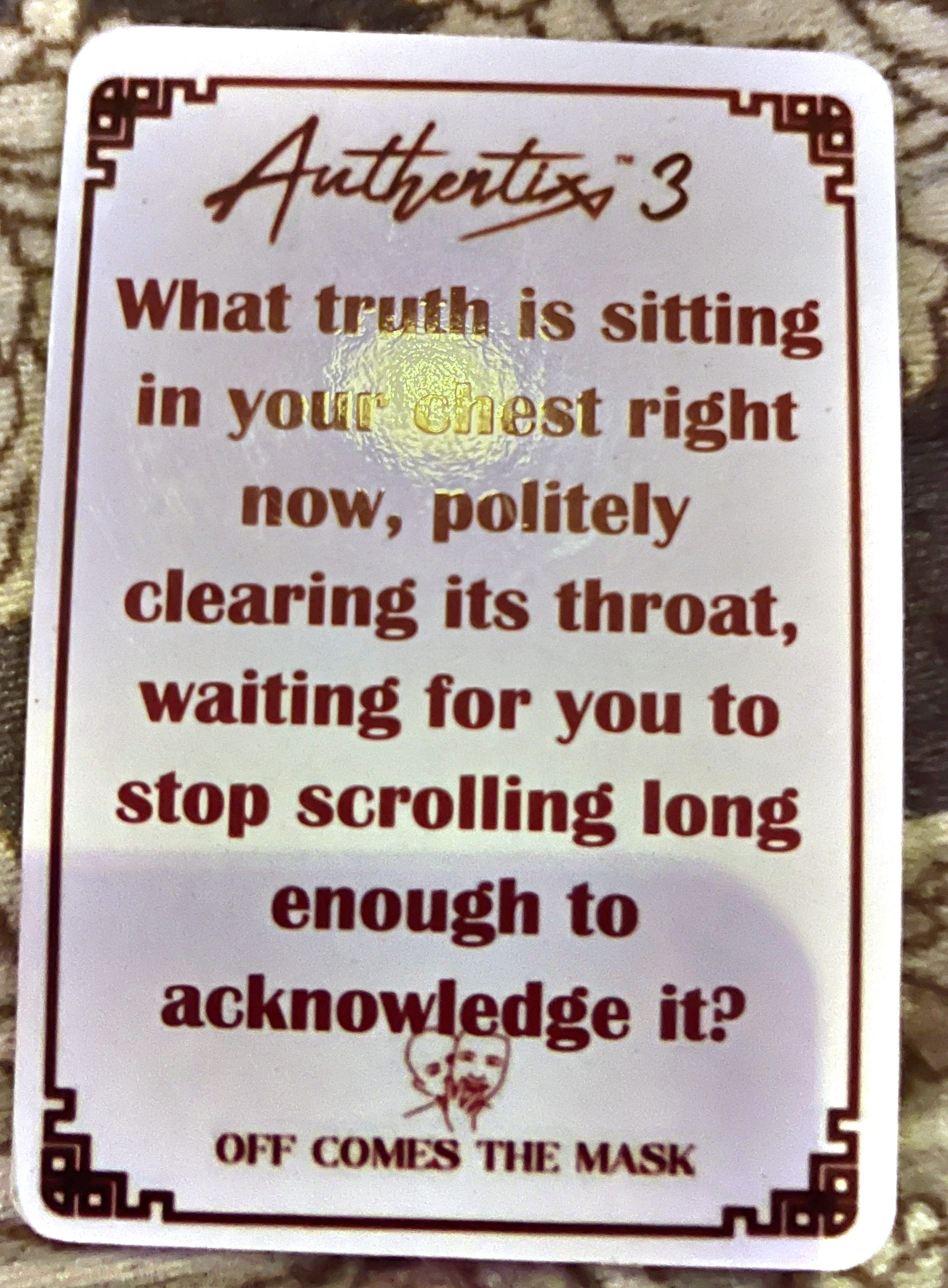
What truth is sitting in your chest right now, politely clearing its throat, waiting for you to stop scrolling long enough to acknowledge it?
I blank. I have been six weeks non stop in self enquiry. If anything is there that I don’t see, it is a total blind spot. I feel that familiar experience, being lost. Having no sense of direction. I recall Wendell Berry: “It may be that when we no longer know what to do, we have come to our real work, and when we no longer know which way to go, we have come our real journey”. But philosophizing is my usual coping mechanism.
The truth is that my current experience is brutally uncomfortable and even as I guide people through such situations as my work, I am powerless on my own story.
I think “the guide is lost”. I smile at the irony.
Twenty years of helping other people find their way. The deck does not care. It asks the same question of everyone and waits.
So what is actually happening?
I have been going to the Game for a while, and I leave with the same question every time.
People talk about what they usually do not talk about.
That is the whole of it. And look at the conditions under which they manage it. Strangers. A restaurant. Eleven in the morning. Sober. No history between them and no future obligation. Nobody has earned anybody’s trust, because there has not been time.
These are not the conditions you would design for intimacy.
By any reasonable account this should produce small talk.
Then there is what does not happen. Nothing gets resolved. Nobody is advised, corrected, or talked out of anything. A person says the hardest thing they have said in a year sometimes, the room takes it, and somebody draws the next card. You would expect that to land as abandonment. It does not. It appears to be the point.
And when it is over, nobody goes home.
The cards cannot carry the explanation. I have read all three decks. They are good questions, built with care over years, and they are still only questions on pieces of card.
I do this work for a living. I sit with people over months, and I have some idea of what it costs to get someone to say a true thing out loud. A deck of cardboard, a long table and ninety minutes arrives somewhere adjacent, with people who met that morning.
That is both humbling and interesting. So I went looking for whether anyone has studied what happens in a room like that.
Many studies. Decades of serious scientific work. Many approaches, none of them involving a card game.
What I found changed how I understand my own work, and most of it contradicts many obvious explanation.
What is actually happening in the authenticity game is where I have written up my findings. Maybe you’ll enjoy it. It does not matter really.
The psychology is the map. The Game is the terrain. Nothing replaces that.
Join the Game?
PS: “Change Your Story, Change The World” is a storytelling endeavor that looks deeply into the psyche that creates the stories we live by.
Because the stories we tell are the reality we live.
And because they live in the body as much as in the mind, I have designed “The 5 Bodies Test”. Ten minutes, and it will tell which part of you is asking for attention. I read every result myself and send back a written reading, free. Take it, or pass it to someone you’ve been thinking about.