

The Paradox
So we have opened the pandora box. Removed the last filter, the anthropocentric frame. I would venture, for the sake of the conversation, that the particular ability to see from a non-species-centered-frame is a particular skill of the human species and I would guess few, if any, other species can do that. The eagle is not developing a non-eagle perspective. The mycelium is not questioning its mycelium-centrism. What does it mean that only we can ask this question?
The paradox:
the non-anthropocentric view is in itself an anthropocentric skill.
The Trap
From there two options:
Either the human, so confident in its cognitive superiority, claims to see from outside itself entirely, and that could be the ultimate hubris. Just another trap in the process of development of consciousness. Caught in yet another filter we cannot see.
Or this capacity is indeed a specific function of our specie. Hence not the trap anymore but the gift. Not the human transcending its nature through the gift, but rather fulfilling its ultimate nature.
The place where consciousness turns to look at itself through the human instrument.
Abhinivesha
Two thousand years ago, a great sage of yoga philosophy left a pillar of knowledge called The Yoga Sutra. Within it he describes the 5 kleshas (poisons, afflictions) of the human mind. The fifth klesha is called abhinivesha, the clinging to life, and it is described as the greatest barrier towards the highest achievement of enlightenment, or liberation.
The program runs so deep (the desire and clinging to continuity) that the sage Patanjali says it afflicts even the wise. It is not described as a moral failing but like the most ancient biological instruction there is.
And the ability to overcome this affliction is necessary for any human to achieve its greatest potential.
Every other species executes that instruction without question. The bee dies for the hive by instinct. The salmon returns to spawn and die without deliberation.
Possibly, only the human can know the instruction is running, examine it, and choose to act from beyond it. Understanding this is the highest order.
That is the crossing. That is what the last filter dissolving actually means.
Everybody Knew
Different tradition came to it from different directions. Although with different words, they describe the same recognition.
The Bodhisattva, in Mahayana Buddhism, reaches the threshold of nirvana, the complete release from suffering, and turns back. Voluntarily. An act of self-sacrifice for the whole. The vow is to remain in the cycle of birth and death until every sentient being is free (that include non-human species). The dissolution of the boundary between self and other taken to its logical conclusion. When there is no separate self to protect, the question of survival becomes irrelevant.
Christ in Gethsemane asks for the burden to be taken from him. The full human dread, unmasked. Then surrender to God’s will and carry the cross. We don’t celebrate the death, but the voluntary completion. Willingly crossing the threshold Christ could have escaped, could have chosen another road. Yet he chose to walk all the way through. What came out the other side was unrecognizable to most who had known him before.
Nine centuries later, Bagdad. Al-Hallaj, the Sufi mystic, declared Ana’l-Haqq, I am the Truth, I am the Real. In the frame of his time and place (orthodox Islam of the Abbasid caliphate) such a declaration is a death sentence. He knew yet did it anyway. The separate self annihilated not in private contemplation but publicly, completely, without the escape hatch that silence could have provided.
Arjuna on Kurukshetra. The battlefield where everyone loses. His teachers on one side, his family on the other. Krishna’s instruction is not to win, it is to act without attachment to outcome. The fruit of the action belongs to something larger. The action only belongs to you.
Each tradition arrived at the same threshold from a different path. The human capacity to act for the whole without requiring its own continuity as the condition. Not from instinct or compulsion but a choice.
None of these traditions required human survival as the condition of their act.
That is the test. That is what completing the grief curve actually looks like from the inside
The crisis as invitation
Part I traced the way filter dissolves. Each filter once dissolved giving birth to a new reality. Part II name the current reality, the fall, and what is possible when we stop arguing with gravity.
The crisis is upon us. The time is counted.
The system we built is no longer able to absorb the disruptions it created.
This is the moment that most demands the release of abhinivesha, and also the moment that most calls forth the highest human capacity. Not to avoid the collapse, that is denial of reality, but through it.
The climate crisis is the crucifixion of our civilization, its final test.
The crisis is not punishment, rather our responsibility.
The human that can conceive of its own non-necessity and act from that place without despair is expressing the most fully human trait possible. It is the full weight of what consciousness makes possible, carried voluntarily, with eyes open, because it is ours to carry.
The Alchemist Loop
And like the ultimate alchemist’s trick, the journey to nowhere arrived here. Not where it started and not at a destination either.
At the recognition that the capacity to release the destination was always the point.
The Bhagavad Gita calls it nishkama karma, action free from desire. It is neither passive nor resigned. The full force of engagement, with the outcome released. Arjuna doesn’t put down his bow. He picks it up differently.
The Tao Te Ching says the same from stillness: the sage completes the work and moves on. Without claiming or naming anything. The river doesn’t decide to carve the canyon. It simply flows, without agenda, and the canyon appears.
Two instructions, same recognition. Act fully. Hold nothing.
This is what the traditions were pointing at. This is what the crisis is asking. Not to stop being human, to become more fully what the human was always capable of being. The one species that can know its own impermanence, feel the full weight of that knowledge, and choose to act from beyond it anyway.
Consciousness doesn’t need the human to continue.
But the human, this particular temporary configuration, this brief instrument of awareness, has the specific ability to know that, to choose from that knowing, and to find in that choice not diminishment but the fullest expression of what it was always capable of.
The journey to nowhere turns out to have been the most human journey possible.
“Change Your Story, Change The World” is a storytelling endeavor that looks deeply into the psyche that creates the stories we live by.
Because the stories we tell are the reality we live.
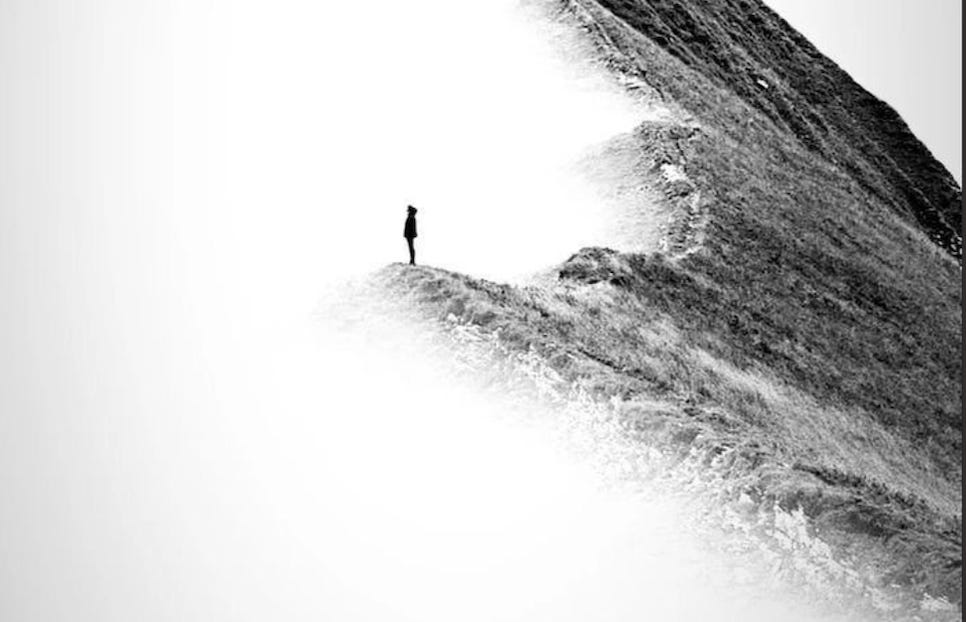
The image this creates for me is the sage who completes their work, and walks on into transparency, both literal and spiritual. The degree to which we are willing to become transparent, to ourselves and each other, is the degree to which we are most faithful to the Ultimate.